

A mid-sized logistics company signed a three-year contract with a SaaS platform vendor in Q2. By Q4, the vendor had pivoted its product roadmap, deprecated two APIs the company depended on, and raised prices by 40% citing “enterprise tier realignment.” The technology lead had done a standard due diligence checklist. Security compliance: checked. Contractual SLAs: checked. Reference calls: checked. None of it mattered, because none of it had looked at the right things.
This is not an unusual story, over the course of managing more than 1,200 technology projects, the pattern recurs with remarkable consistency: vendor risk is the category leaders feel most confident about and most frequently get wrong. The confidence is misplaced. It derives from a conflation of procurement hygiene with genuine risk assessment — a procedural check mistaken for strategic analysis.
This article is about what actually makes vendor risk dangerous, how to think about it systematically, and what a rigorous evaluation framework looks like in practice.
The Structural Problem: Vendors Are Not Static Entities
The foundational error is treating vendor selection as a one-time decision applied to a static counterparty. Vendors change. Their financial condition changes. Their leadership changes. Their product strategy changes. Their customer concentration changes. A vendor that was a credible, stable partner at contract signing may be a distressed acquisition target eighteen months later.
Technology leaders focus disproportionately on the point-in-time snapshot — the RFP response, the demo, the security audit.
What they underweight is trajectory: where is this vendor going, and does that trajectory align with where we need to go?
This matters because technology dependencies are not easily severed. When your core ERP, your data pipeline, your customer identity layer, or your deployment infrastructure is tightly coupled to a vendor, the switching cost is not just financial. It is organisational: retraining, re-integration, re-testing, re-negotiating. The asymmetry of the relationship — high cost to exit, relatively low cost to enter — is where vendors extract value and where leaders lose leverage.
The second structural problem is that vendor risk tends to be evaluated in isolation rather than in aggregate. A single vendor dependency is manageable. Five interconnected vendor dependencies, each with their own risk profiles, create a compound exposure that multiplies rather than adds. Most organisations do not have a complete map of their vendor dependency graph, which means they cannot reason clearly about systemic exposure even when they think they can.
The Four Dimensions of Vendor Risk That Actually Matter
A serious vendor risk framework does not begin with contract terms. It begins with a structured assessment across four dimensions that together determine the true exposure profile of any vendor relationship.
Strategic Alignment Risk
The most under appreciated dimension. Strategic alignment risk is the probability that the vendor’s long-term product direction diverges from your operational needs — and the cost of that divergence.
This divergence can take several forms. A vendor may be acquired, shifting product priorities to serve the acquirer’s customer base rather than yours. A vendor may pivot upmarket or downmarket, deprioritising the feature set you depend on. A vendor may enter financial distress and begin cannibalising product investment to extend runway. Or a vendor may simply make honest strategic choices — doubling down on a market segment you are not in, or deprecating a legacy module to fund a new architecture — that leave your integration stranded.
The diagnostic questions here are not about the product as it exists today. They are about the vendor’s investor base and burn rate, their recent hiring patterns (are they growing engineering or shrinking it?), their recent customer wins and losses at the segment level, and the durability of their differentiation in a competitive market. A vendor winning primarily on price in a commoditizing category is a different risk profile than one winning on proprietary capability in a defensible niche.
Operational Dependency Depth
Not all vendor dependencies are equal in their criticality or their replaceability. Operational dependency depth measures how deeply embedded the vendor is in your core workflows and how reversible that embeddedness is.
A vendor providing a peripheral analytics dashboard sits at the shallow end of this spectrum. A vendor providing the identity and access management layer for your entire product sits at the deep end. Between these extremes lie dozens of gradations, and most organizations have not done the work to map their portfolio along this spectrum.
Depth has two components: workflow criticality (what breaks if this vendor fails or changes?) and architectural lock-in (how much would it cost to replace them?). A vendor can be critically important to a workflow but architecturally replaceable — a commodity payment processor, for instance. Or a vendor can be relatively peripheral to core workflows but architecturally entrenched — a bespoke data transformation tool that has become the undocumented glue connecting multiple systems.
The governance implication is that the depth assessment should drive contract terms, integration architecture decisions, and the investment in abstraction layers. You negotiate differently — and build differently — when you understand the actual depth of a dependency.
Concentration and Single-Point-of-Failure Risk
Every technology architecture has nodes whose failure would cause disproportionate damage. Vendor concentration risk is the degree to which those critical nodes are controlled by a single counterparty.
This is distinct from the number of vendors. An organization with forty vendors but with all its compute, storage, and networking concentrated in a single cloud provider has high concentration risk despite apparent vendor diversity. An organization with ten carefully selected vendors, each covering a distinct functional domain with documented alternatives, may have low concentration risk despite a smaller portfolio.
Concentration risk compounds when vendors are interdependent. If your primary data warehouse vendor, your ETL pipeline vendor, and your business intelligence vendor all rely on the same underlying infrastructure provider, a failure or pricing change at the infrastructure level cascades through all three dependencies simultaneously. This kind of second-order concentration is rarely mapped and almost never surfaced in standard vendor assessments.
Contractual and Governance Risk
This is the dimension leaders think they have covered. Often they do not.
The gap is not typically in the presence of contract terms but in their enforceability and their completeness relative to the actual risks. SLA clauses that define uptime but not performance degradation. Data portability provisions that are technically present but practically unusable because they require formats the vendor does not natively export. Termination clauses that allow exit but not within a timeframe that prevents operational disruption.
Beyond the technical adequacy of individual clauses, there is the question of governance during the contract lifecycle. Who owns the vendor relationship on your side? Who monitors compliance? Who has standing to escalate? In many organisations, vendor governance is a procurement function that executes at contract initiation and then effectively disappears. The relationship drifts, changes accumulate unreviewed, and the organisation discovers its actual exposure only when something breaks.
The Vendor Risk Quadrant: A Working Framework
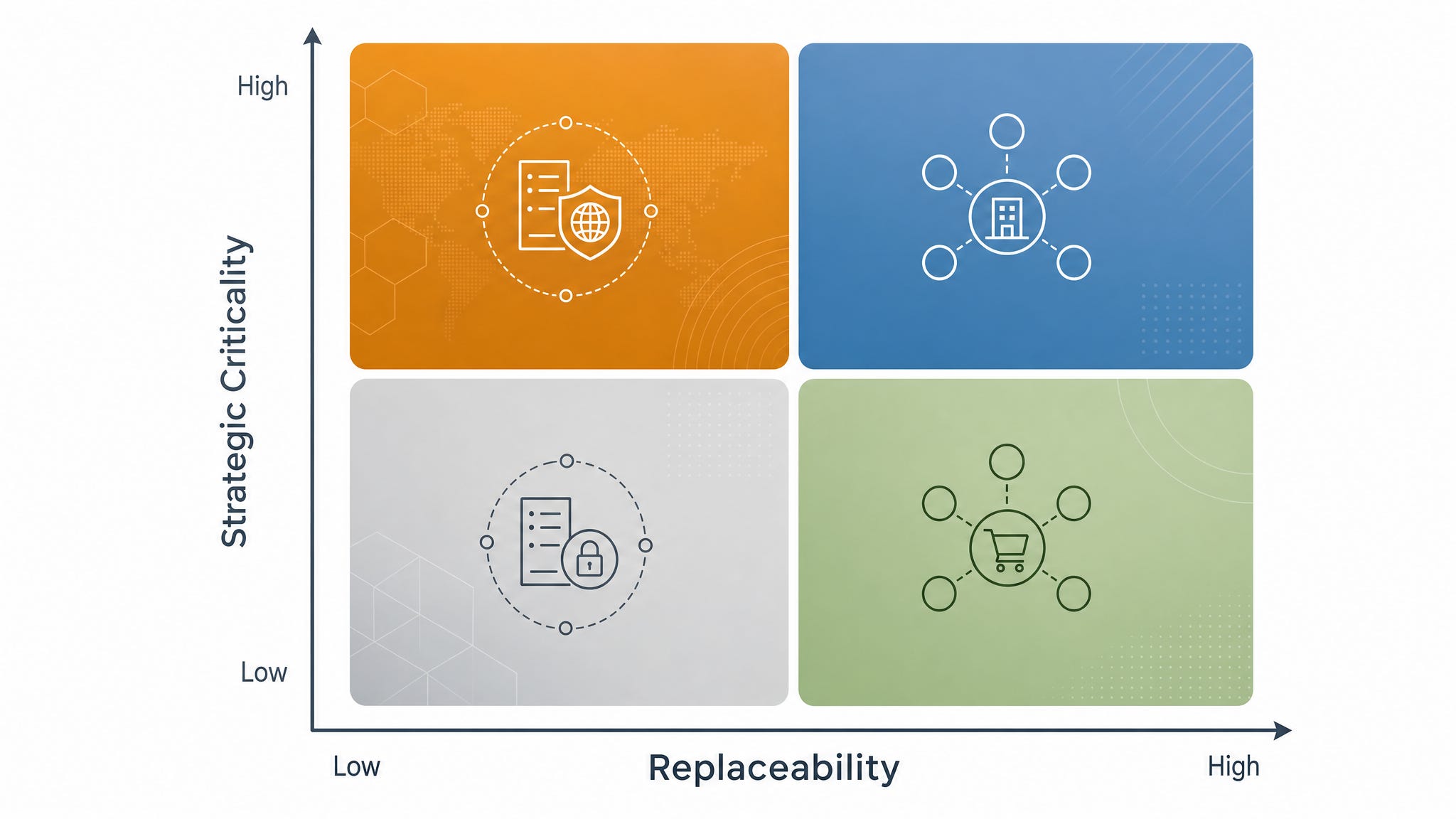
A useful organising model is to plot vendors on two axes: strategic criticality (how important is this vendor to core business operations?) and replaceability (how difficult and costly is it to replace this vendor?).
This produces four quadrants, each with a distinct governance posture.
High Criticality / Low Replaceability— These are your sovereign risks. The vendors in this quadrant have the most leverage and create the most exposure. They warrant dedicated relationship management, architectural investment in abstraction and exit planning, enhanced contractual protections, and regular strategic reviews. The goal is not to eliminate these relationships — some critical dependencies are unavoidable — but to ensure they are chosen deliberately, governed rigorously, and not entered into without clear-eyed understanding of the exposure.
High Criticality / High Replaceability — These vendors matter operationally but can be replaced if necessary. The governance focus here is on maintaining genuine replaceability: keeping integrations standardised, documenting replacement procedures, and periodically testing that alternatives are actually viable rather than theoretically available. The temptation in this quadrant is to let replaceability decay through accumulated customisation and integration debt.
Low Criticality / Low Replaceability — These are vendors that have become entrenched without being important. Often the result of legacy acquisitions or organic growth without governance oversight. The strategic goal is to rationalize: either increase standardization to restore replaceability, or phase out the dependency entirely. These vendors are invisible risks — low enough criticality that they don’t attract attention, but entrenched enough that their failure would cause disproportionate disruption relative to their apparent importance.
Low Criticality / High Replaceability — Standard vendor management applies. Periodic review, basic contractual hygiene, and no disproportionate investment in governance. This is the quadrant where most vendor management attention is concentrated, because it is the safest and most comfortable. The risk is that it consumes governance bandwidth that should be directed at the other three quadrants.
The framework is not static. Vendors move across quadrants as products evolve, architectures change, and strategic priorities shift. A quarterly review of the quadrant mapping — brief but rigorous — is more valuable than an annual comprehensive assessment.
Implementation: Where This Framework Breaks Down
No framework survives contact with organisational reality without modification. The practical challenges in implementing this approach are predictable and worth addressing directly.
The first is data availability. Assessing strategic alignment risk requires information that vendors will not voluntarily provide and that is often not publicly available. Private vendors do not disclose financials. Product roadmaps are guarded. Customer attrition data is confidential. The workaround is triangulation: conversation with peers and industry contacts, pattern analysis from job postings and product updates, and structured dialogue with vendor account teams that goes beyond the standard renewal conversation. None of this is perfect, but directional signal is enough to calibrate relative risk.
The second is organisational ownership. The quadrant framework requires someone to own it — to maintain the mapping, drive the reviews, and translate assessments into governance actions. In most technology organizations, this falls into a gap between procurement (which owns contracting), IT (which owns operations), and the business (which owns strategy). The governance failure is structural, not personal. The fix is explicit assignment of vendor relationship ownership at the appropriate level for each quadrant, with clear accountability for the review process.
The third is the politics of existing relationships. Vendors in the high criticality / low replaceability quadrant are often long-standing relationships with significant internal champions. Raising strategic alignment or concentration risk against a vendor whose implementation was championed by the CTO or a powerful business unit leader is not a comfortable conversation. The framework is only useful if it is applied with sufficient independence from the relationship dynamics it is meant to govern. This requires explicit leadership commitment to the process.
The fourth is the temptation to optimize the framework into uselessness by treating every vendor as high-risk. Risk prioritisation only works if it actually prioritizes. An organisation that applies sovereign-risk governance to forty vendors has not managed vendor risk; it has created governance theater that exhausts the organization without protecting it from anything.
The Strategic Reflection: Vendor Risk as Architecture
The deeper insight that experience in complex technology programs produces is this: vendor risk is not primarily a procurement or legal problem. It is an architecture problem.
The choices that determine vendor exposure — how tightly coupled to integrate, how much to standardise versus customise, how to structure data ownership, how to design for portability — are made by architects and engineers in the early phases of a program, often without explicit consideration of the vendor risk implications. By the time procurement is negotiating the contract, the architectural decisions that will determine the actual exposure have already been made.
This means that vendor risk governance needs to move upstream. It needs to be present in architecture reviews, in integration design decisions, in data modeling, and in the selection of infrastructure patterns. The question “how would we exit this dependency?” should be answered before the dependency is incurred, not after.
For technology leaders, the practical implication is governance integration rather than governance addition. This is not another process layered on top of existing processes. It is the introduction of vendor risk framing into decisions that are already being made — architecture reviews that are already happening, integration designs that are already being drawn, contract negotiations that are already in progress. The marginal cost of doing this well is lower than it appears. The marginal benefit, measured in avoided crises and preserved leverage, is higher than most leaders estimate until the day they find themselves in the logistics company’s position, looking at a 40% price increase on a system they cannot afford to leave.
The leaders who manage vendor risk well are not the ones who sign the best contracts. They are the ones who build architectures that preserve optionality, governance processes that maintain situational awareness, and organizational cultures where the uncomfortable question — “what happens if this vendor is not there in two years?” — is asked routinely and answered honestly.
---
*Gustavo De Felice is a governance architect and strategic advisor with experience across 1,200+ managed technology projects. He writes on project governance, systems thinking, and the operational realities of building technology organizations that last.*
---