

The CFO asked a straightforward question: what’s the return on the AI programme?
The head of operations had numbers ready. Hours saved per week on report generation. Reduction in manual data entry. Cost per processed invoice, before and after. Clean, comparable, trending in the right direction. The CFO nodded, the budget was renewed, and everyone moved on.
Twelve months later, the same programme was quietly wound down. Not because it failed to save hours. It did, reliably. But the company had made three strategic decisions in that period — a market expansion, a supplier renegotiation, and a product pivot — all of which were delayed, distorted, or made with incomplete information because the data intelligence layer that the AI programme was supposed to enable had never actually been built. The team had been so focused on automating what was already being done that they hadn’t built the capability to do what wasn’t being done at all.
The numbers looked good. The return was negative.
The Measurement Trap
There’s a well-known problem in performance management: you get what you measure. Applied to AI ROI, this becomes particularly dangerous, because the things that are easiest to measure — task completion time, volume throughput, cost per unit — are rarely the things that actually determine whether an AI investment creates lasting organisational value.
This is not a new insight. Goodhart’s Law has been with us for decades: when a measure becomes a target, it ceases to be a good measure. But AI programmes have a specific way of falling into this trap, one that’s worth naming clearly.
Most AI implementations in operations begin with a process automation rationale. There’s a slow, manual, error-prone workflow. AI can accelerate it, reduce the error rate, free up headcount. The efficiency case is real, the numbers are calculable, and the business case writes itself. So the initiative gets funded on efficiency grounds, and success gets measured on those same grounds.
What happens next is almost predictable. The initiative delivers the efficiency gains. The measurement framework validates it. The team optimises toward those metrics. And in doing so, they systematically deprioritise the harder, slower, less measurable work — the process redesign, the capability building, the integration with decision-making workflows — that would have turned a productivity tool into a strategic asset.
By the time it becomes obvious that the programme delivered efficiency without capability, the budget cycle has moved on, the team has been reassigned, and the initiative is written up as a success that somehow didn’t change anything fundamental.
Efficiency vs. Compounding Capability
The distinction worth making here is between efficiency gains and compounding capability — and understanding why the latter matters far more at scale.
An efficiency gain is linear. If AI reduces the time to process a supplier invoice from four minutes to forty seconds, that’s a six-fold improvement on that specific task. You can model it, measure it, and put a figure against it. It doesn’t interact with anything else in the organisation. It just makes one thing faster.
Compounding capability is different. When AI changes the quality of information available to decision-makers — when it surfaces patterns in operational data that were previously invisible, flags risks earlier, or enables faster iteration on strategy — the returns aren’t linear. They accumulate across every decision that uses that capability. And they compound, because better decisions create better data, which trains better models, which enable better decisions.
The problem is that compounding capability is genuinely hard to measure at the point of investment. You can’t easily model “better decisions over the next three years” the way you can model “forty seconds per invoice.” So organisations default to what they can quantify, and they end up building AI programmes that are sophisticated on paper and shallow in practice.
This isn’t an argument against measuring efficiency. Efficiency gains are real value, and they matter, particularly in operations where margin is tight. But they should be understood as the floor of AI ROI, not the ceiling. If your measurement framework only captures efficiency, you’re systematically undervaluing the investments that will compound and overvaluing the ones that won’t.
The Time-Lag Problem
There’s a further complication that most AI ROI frameworks fail to account for: the returns don’t arrive when you expect them.
In conventional capital expenditure — buy a machine, it produces output, you measure the yield — the relationship between investment and return is reasonably proximate. In AI operations programmes, there’s almost always a lag, and it’s longer than organisations expect. In practice, the meaningful returns on operational AI often don’t become fully visible until twelve to eighteen months after deployment, sometimes longer.
The reasons are structural. First, AI models in operational contexts don’t perform at their best from day one. They improve as they’re exposed to more data, as edge cases are identified and handled, as the organisation learns how to prompt, configure, and integrate them effectively. The early performance numbers — often the ones used to validate or kill a programme — are the worst numbers you’ll see.
Second, the humans who work with AI systems need time to adapt. The full productivity benefits of AI-assisted work don’t materialise until people have genuinely changed how they work, not just added a new tool to an existing workflow. That adaptation takes months, and it often looks like disruption before it looks like improvement.
Third, the strategic returns — the compounding capability discussed above — require that the organisation actually changes how it makes decisions. That’s a cultural and structural change that happens slowly, if it happens at all. Organisations that measure AI ROI at six months are often measuring the disruption phase, not the value phase.
The practical implication of this is uncomfortable: the evaluation timelines built into most AI business cases are wrong. Not slightly wrong — structurally wrong. And the consequence is that valuable programmes get cut before they deliver, while shallow programmes survive because their limited returns arrive quickly and look tidy in a quarterly review.
A Framework for Measuring What Actually Counts
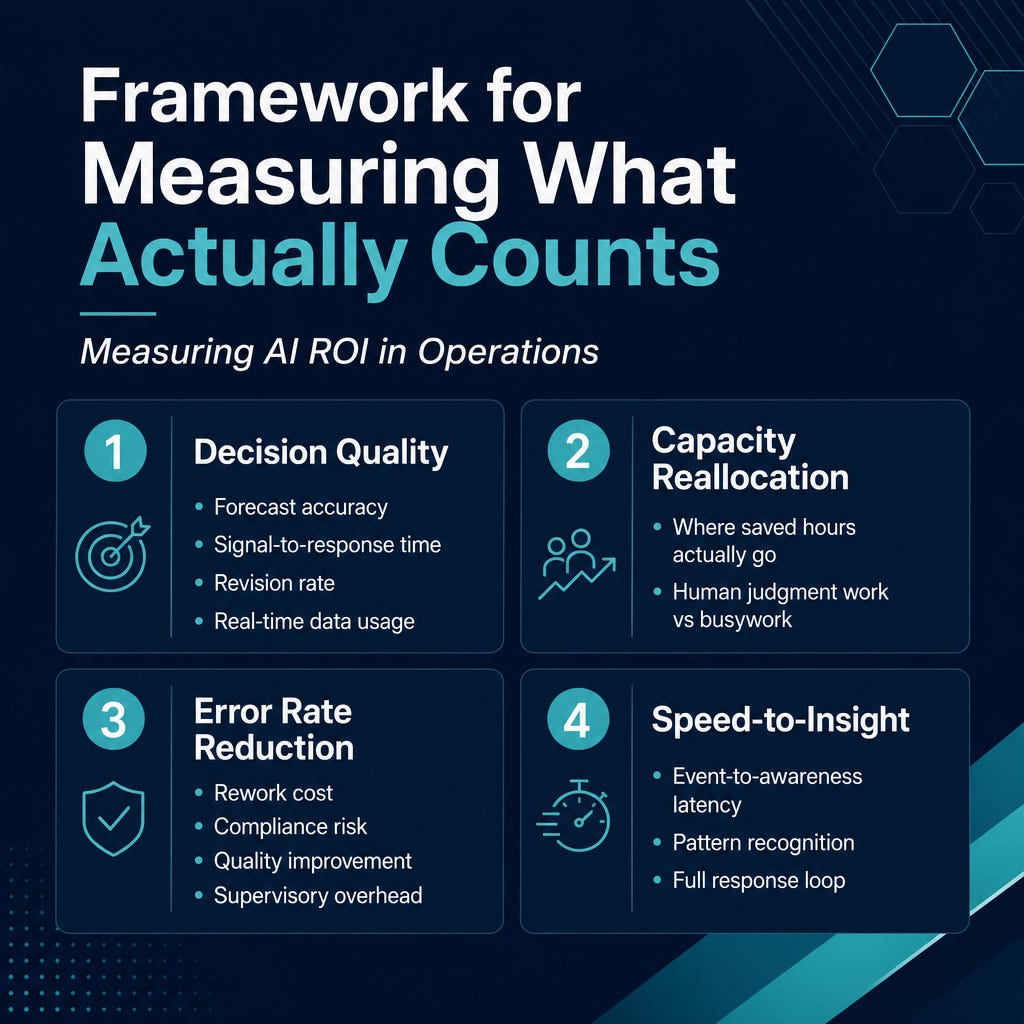
If the standard efficiency metrics are insufficient, what should organisations measure instead? The answer isn’t to abandon quantification — it’s to expand the measurement framework to capture the right signals. Here is a practical model built around four dimensions.
Decision Quality
The most important thing AI can improve in operations is not the speed of execution but the quality of decisions. This is hard to measure directly, but it’s not unmeasurable. Decision quality can be proxied through metrics like: the accuracy of forecasts used in planning, the lead time between signal detection and management response, the rate of decisions that required revision within ninety days, and the volume of decisions supported by real-time data versus historical averages.
None of these are perfect proxies. All of them are more meaningful than cost-per-task. And tracking them over time — building a baseline before AI deployment and monitoring trends after — provides a genuinely useful picture of whether AI is changing how the organisation thinks, not just how fast it works.
Capacity Reallocation
Headcount reduction is the crudest measure of AI value, and often a misleading one. The more interesting question is where capacity goes when AI takes over routine work. If the hours saved on report generation are absorbed into other routine tasks, the real return is low. If those hours are redirected toward work that requires human judgment — client relationships, strategic analysis, exception handling — the return is much higher, even if the headcount number doesn’t change.
Measuring capacity reallocation requires a qualitative layer alongside the quantitative one. It means tracking not just how many hours are saved, but what people do with those hours. This is harder to systematise than a time-tracking dashboard, but it’s the signal that distinguishes an AI programme that built capability from one that just redistributed busywork.
Error Rate Reduction
Error rates in operational processes are an underutilised ROI signal. In most organisations, the true cost of errors — rework, delay, client impact, compliance risk — is significantly higher than the visible cost. AI-driven error reduction creates value across multiple dimensions simultaneously: direct cost savings on rework, risk reduction on compliance failures, quality improvements in outputs, and reduction in the supervisory overhead required to catch and correct mistakes.
Error rate is also a relatively clean measurement. Unlike decision quality, which requires careful proxy construction, error rates in most operational processes are already being tracked (or could be with minimal additional instrumentation). Establishing a pre-deployment baseline and monitoring the trend creates a straightforward signal that captures real operational value without requiring complex modelling.
Speed-to-Insight
In fast-moving operational environments, the latency between an event occurring and the relevant people being aware of it is a significant source of value destruction. Suppliers fail silently. Performance degrades before anyone notices. Risks accumulate without triggering review. AI-driven monitoring and anomaly detection reduces this latency — and the reduction is measurable.
Speed-to-insight can be tracked as the average time from event occurrence to management awareness, measured across key operational processes. It’s a useful composite metric because it captures both the quality of the AI’s pattern-recognition capability and the organisation’s ability to act on what the AI surfaces. A fast alert that goes unread is worth nothing; the metric forces the organisation to think about the full response loop, not just the detection.
The Governance Question
There’s a dimension to AI ROI measurement that most frameworks skip over, and it’s arguably the most important one: who owns it?
In most organisations, AI initiatives are owned by technology or operations functions. The measurement of their success is delegated to whoever ran the project — which creates an obvious structural problem. The people who built the business case are measuring whether the business case was right. The incentives are misaligned, and the numbers tend to reflect it.
The governance structure for AI ROI measurement should mirror the governance structure for any significant capital programme. That means a measurement owner who is independent of the implementation team, a pre-agreed set of metrics established before deployment (not retrofitted to whatever came out well), a review cadence that aligns with the time-lag reality of AI returns rather than the quarterly rhythm of most budget cycles, and a clear escalation path for programmes that are underperforming on the metrics that matter.
This sounds straightforward, and it is. But in practice, most AI programmes lack any of it. They’re measured by the people who built them, on the metrics those people chose, at the intervals that make the numbers look best. The result is a systematic overstatement of AI ROI across the industry — not through deliberate dishonesty, but through structural misalignment between who measures and who gains from the measurement.
When nobody owns AI ROI measurement — when it’s everyone’s responsibility in theory and nobody’s in practice — what gets measured is whatever’s easiest to measure, at whatever moment makes it look most favourable. That’s not measurement. It’s performance management of the measurement itself.
Implementation Realities
None of this is straightforward to operationalise, and it would be intellectually dishonest to pretend otherwise.
Building a measurement framework around decision quality, capacity reallocation, error rates, and speed-to-insight requires more instrumentation, more organisational alignment, and more patience than the standard efficiency dashboard. It requires a baseline measurement programme before deployment — which means committing resources to measurement before any return is visible. It requires stakeholders who are willing to accept that the headline numbers might look worse in the first year. And it requires governance structures that most AI programmes don’t currently have.
There are also genuine trade-offs in prioritising the harder measurements. Organisations that invest heavily in measurement infrastructure can over-invest relative to the scale of the AI programme itself. There’s a real risk of building a sophisticated measurement system for an initiative that hasn’t yet earned that level of attention. The right answer is proportionality: the measurement framework should match the strategic ambition of the programme. For a pilot or proof of concept, efficiency metrics may be sufficient. For a programme that’s meant to change how the organisation operates, they’re not.
The time-lag problem also creates a governance challenge that’s worth acknowledging directly. Telling a board or executive committee that they won’t see meaningful returns for twelve to eighteen months requires credibility, clear logic, and — frankly — a tolerance for ambiguity that not all organisations have. In environments where quarterly results dominate strategic thinking, the right measurement framework is sometimes politically impossible, which is itself a signal worth surfacing early in the investment conversation.
What This Means for Leaders
The question the CFO asked at the start of this piece — what’s the return on the AI programme? — is the right question. The problem is that most organisations have built measurement systems that give a confident, precise answer to a slightly different question: how efficiently did the AI execute the tasks we gave it?
Efficiency of execution is not the same as strategic return. In some contexts it’s a good proxy; in others it actively misleads. The difference between organisations that build genuine AI capability and those that run expensive automation projects and wonder why nothing fundamental changed often comes down to this: the first group measures what they’re trying to achieve. The second group measures what’s easy to measure, and then reverse-engineers the objective to fit.
The framework above isn’t a complete solution — no framework is. But it provides a starting point for shifting the measurement conversation from activity to outcome, from cost per task to decision quality, from headcount saved to capability built.
More importantly, it forces the governance question into the open: not just how are we measuring AI ROI, but who owns that measurement, when are they measuring it, and what happens when the numbers don’t look good? Those questions don’t have comfortable answers. But they’re the right ones to be asking before the investment is made, not twelve months after the programme has been quietly wound down.
The returns on well-implemented operational AI are real. But they’re not linear, they’re not immediate, and they’re not always where you’re looking. The organisations that understand that — and build measurement systems that reflect it — are the ones that will actually see them.